
Stop rehearsing answers; Start building a story
Most interview preparation fails the moment the panel asks something unexpected. A senior academic used the CRAFT framework to build a narrative instead of a script, adapted in the room, and got the role. Here's how he did it, with a template you can use.
Structure without the script: what a senior interview taught me about CRAFT
Most interview preparation fails in the same way. We rehearse answers to the questions we expect, then the panel asks something slightly different and the rehearsed answer no longer fits.
The problem isn't preparation. It's preparing answers instead of preparing a narrative.
A client's story
A senior academic I've worked with on two projects recently told me he'd used CRAFT to prepare for a university leadership interview. He got the role.
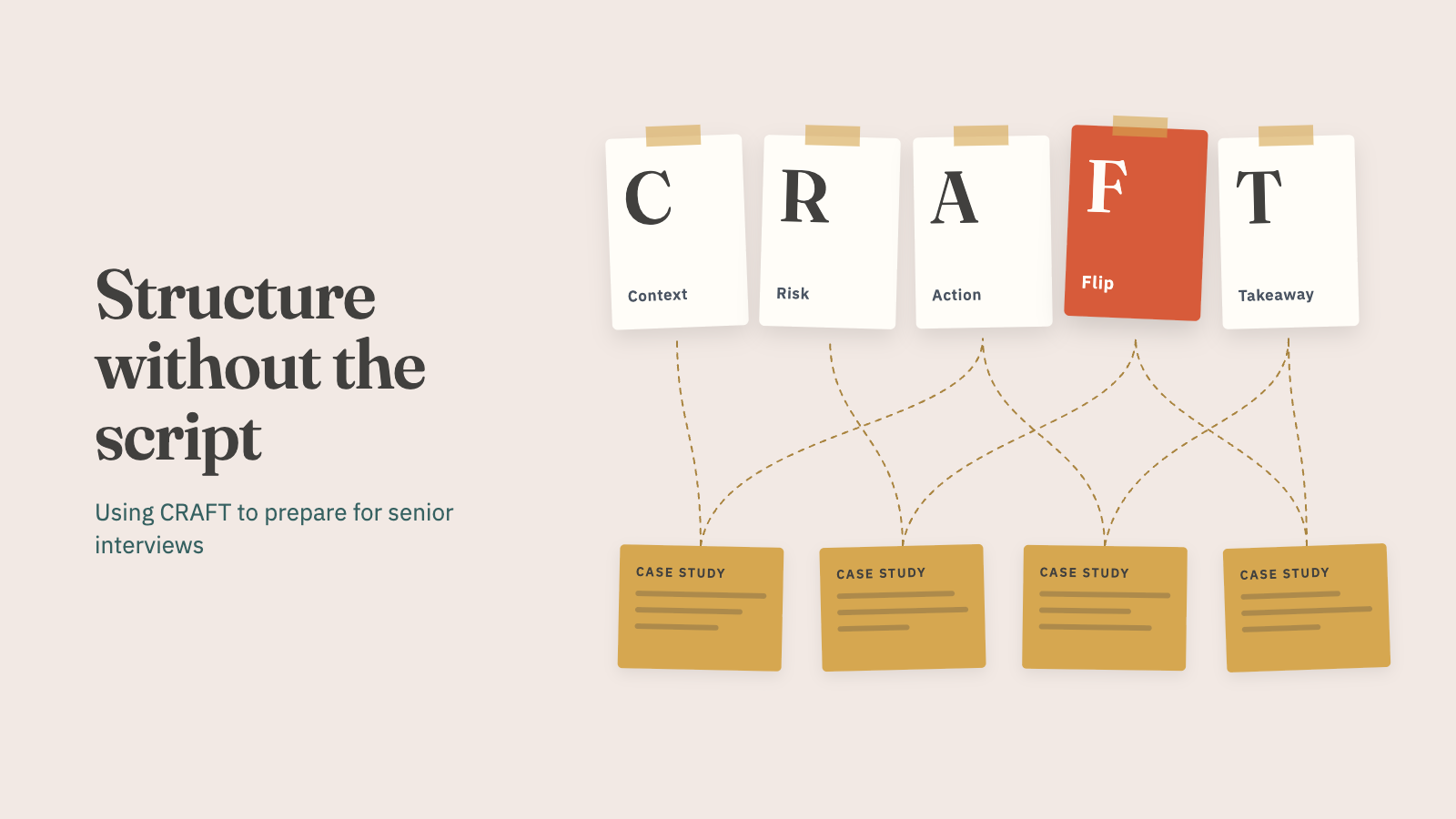
What interested me was how he used it. He didn't write answers. He built two things:
A CRAFT narrative of his case for the role: the Context he'd be stepping into, the Risks at stake, the Actions he'd take, and the Flip, the shift in thinking he'd bring. It was written as if for a presentation, even though the panel hadn't asked for one.
A storyboard of case studies from his career, mapped against the lines of questioning he thought the panel might take.
In his words:
"When the questions came in slightly different forms from those I'd anticipated, I could draw organically on the Context, Risks, Actions and Flip I'd worked through, combine it with a case study of my past work and adapt this in the moment."
Why this works
A script breaks when the question changes. A narrative doesn't, because it isn't tied to a question. It's tied to what you believe and why.
The case studies then do the proving. Any question becomes a matter of picking the right example and connecting it back to the narrative. The structure sits underneath; the answer comes out in your own words, in the moment.
He put the result simply: CRAFT gave him a clear underlying narrative "without making my answers feel scripted".
Try it yourself
Before your next interview, promotion panel or board appointment:
Context: What does this organisation need right now, and why you, why now?
Risk: What happens if they get this appointment wrong, or change nothing?
Action: What would you actually do in the first six to twelve months?
Flip: What's the shift in thinking you bring that others won't?
Takeaway: If the panel remembers one sentence about you, what is it?
Then list five or six case studies from your career. Map each against the questions you expect. You'll find most examples can answer several.
Want help with it?
I now offer CRAFT interview preparation as a standalone service for senior appointments. Book a free 30-minute chemistry call to talk it through.